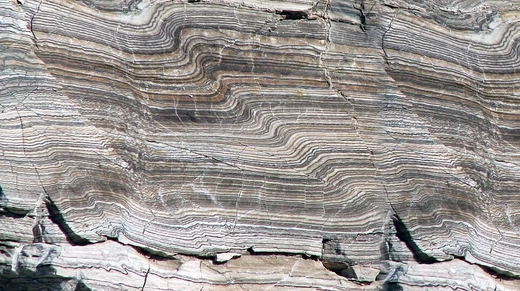
Telluric iron
Rare terrestrial metallic iron found in Greenland.

Wikipedia / Wikimedia Commons
Telluric iron, also known as native iron, is a form of iron that comes from Earth itself, found as a solid metal rather than locked inside ore. It is exceptionally uncommon; the only significant deposit known anywhere is in Greenland.
Nearly all iron on Earth’s surface exists as ores, not metal. For a long time, scientists thought any metallic iron had turned into rust during the Great Oxidation Event, about two billion years ago. Until the late 1800s, the only metallic iron people knew about came from meteorites—space rocks that fell to Earth. The name “telluric” comes from the Latin *Tellus*, meaning the planet Earth, to set it apart from those space rocks.
Telluric iron looks a lot like meteoric iron: it has nickel and shows Widmanstätten patterns. But it usually has only about 3% nickel, which is less than any known meteorite (none have been found with under 5%). There are two types, both with similar amounts of nickel and other impurities. The big difference is carbon content, which changes how hard, workable, and meltable the metal is.
This iron formed deep in Earth’s mantle and crust. Small amounts have turned up in various places, but only Greenland’s west coast has major deposits. Even there, the metal varies wildly in shape and makeup from one spot to another—places like Uivfaq, Asuk, Blaafjeld, and Mellemfjord all differ. What they share is that the deposits are found in dikes (fractures filled with lava) or extrusions where molten rock flowed to the surface. They also all occur alongside graphite-rich feldspar, which likely explains the high carbon and low oxide content. It’s unclear whether this iron somehow escaped oxidation during the Great Oxidation Event, or if it started as beds of ore and coal that got subducted and then naturally smelted in lava, thanks to the reducing environment created by the carbon-rich feldspar.
In Greenland, telluric iron appears in nearly every phase of iron-carbon alloy, with very different crystal structures. Sometimes it’s mixed into basalt as tiny, sharp-edged grains; other times those grains clumped into pea-sized droplets that crystallized into round or oblong shapes. In some places, the dike or extrusion is almost pure, high-carbon cast iron, which could flow into cracks more easily because it’s less viscous and melts at a lower temperature. This cast iron often has a crust of basalt or contains basalt c
- type
- Native metal
- composition
- Iron with 0.05–4% nickel, variable carbon
- major_deposit
- Greenland (Disko Bay area)
- other_deposits
- Kassel, Germany (depleted); minor deposits worldwide
- known_for
- Only known major terrestrial metallic iron deposit; used by Inuit for tools
Lore & Background
Telluric iron is metallic iron that formed within the Earth's mantle and crust. The only known major deposits exist in and near Disko Bay, Greenland, found in dikes or extrusions of basalt rock. The deposits vary drastically in shape and composition, even in the same region. All deposits are associated with graphite-rich feldspar, which likely contributed to the high carbon content and low oxide presence. In 1870, Adolf Erik Nordenskiöld discovered large boulders of iron near Disko Bay, assuming them to be meteoric because they contained nickel and had Widmanstätten patterns. Gustav Nauckhoff made an expedition in 1871, collecting three large samples that are now in Sweden, Finland, and Denmark. K. J. V. Steenstrup, who accompanied Nauckhoff, disagreed with Nordenskiöld about the origin, noting that the boulders had sharp corners or jagged edges not characteristic of meteorites, and some were encrusted with basalt.
Reader's Guide
Telluric iron is significant because it represents the only known major deposit of native iron on Earth, challenging the long-held belief that all metallic iron had been oxidized during the Great Oxidation Event. Its discovery in Greenland by Nordenskiöld in 1870 initially led scientists to assume it was meteoric, but later observations by Steenstrup raised doubts about that origin. The material is divided into two types based on carbon content: Type 1 is a hard, brittle cast-iron with over 2.0% carbon, used by Inuit as hammer and anvil stones; Type 2 is a malleable nickel-iron with less than 0.7% carbon, used by Inuit to make knives and ulus by hammering small grains into discs inserted into bone handles. The legacy of telluric iron lies in its unique geological formation and its practical use by the Inuit, who were the only people to make tools from it. The deposits remain a subject of study for understanding Earth's geological history and the conditions that allowed native iron to survive.
Did You Know?
- Telluric iron is named after the Latin word Tellus, meaning 'Earth', differentiating it from meteorites.
- Type 1 telluric iron contains 1.7 to 4% carbon and is very hard and brittle, while Type 2 contains less than 0.7% carbon and is malleable.
- The Inuit used Type 2 telluric iron to make knives and ulus by hammering pea-sized grains into discs and inserting them into bone handles.
- A 25-ton block of telluric iron rests outside the Riksmuseum in Stockholm, a 6.6-ton block outside the Geological Museum in Copenhagen, and a 3-ton block in the Museum of Natural History in Kumpula, Helsinki.
More in Structural Geology And Tectonics 1-24
Spotted an error? Know more?
This is a living reference — every entry is fact-audited, and reader corrections feed straight into our audit queue. Suggest an edit · See this site's audit record