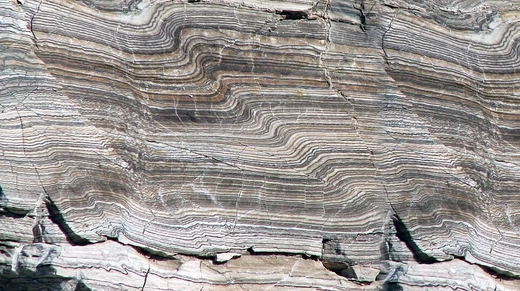
Anticline
Arch-like fold with oldest rocks at core, key for oil traps.
An anticline is a type of fold in structural geology characterized by an arch-like shape with the oldest rock beds at its core. Anticlines are significant because they form structural traps that hold about 80 percent of the world's petroleum, making them economically important for oil and natural gas drilling. They are typically developed above thrust faults during crustal deformations and can be recognized on geological maps by the progressive aging of rock strata toward the fold's center.
- field
- Structural geology
- known_for
- Arch-like fold with oldest beds at core; major petroleum trap
- type
- Geological fold
- distinction
- Distinguished from antiform by known age relationships of rock strata
Lore & Background
An anticline is defined as a convex-up fold where the hinge, or crest, is the point of greatest curvature, and the limbs are the sides dipping away from the hinge. The axial surface is an imaginary plane connecting the hinges of each rock layer; if vertical and symmetrical, the anticline is symmetrical; if tilted, it is asymmetrical. Overturned anticlines have limbs tilted beyond perpendicular, causing beds to flip. Anticlines can be open (limb angle 70–120 degrees) or tight (30 degrees or less). Plunging anticlines have hinges inclined to the Earth's surface, forming V-shaped patterns on maps pointing in the plunge direction. Periclinal folds are doubly plunging anticlines with curved hinge lines, forming elongate domes.
Reader's Guide
Anticlines are crucial in structural geology for understanding crustal deformation and resource distribution. They form primarily above thrust faults, where compression and tectonic motion warp rock strata into arch-like shapes. The uplifted core erodes more deeply than the flanks, creating anticlinal valleys when breached by streams. Economically, anticlines are vital as structural traps for hydrocarbons: low-density oil and gas migrate upward from source rocks until trapped by impermeable caprock such as shale, limestone, sandstone, or rock salt. About 80 percent of the world's petroleum is found in anticlinal traps. Notable examples include the Ghawar Anticline in Saudi Arabia, the largest conventional oil field; the Hill End Anticline in New South Wales, associated with gold deposits; and the Weald–Artois Anticline in England and France, formed during the Alpine orogeny. Anticlines also yield water, minerals, limestone, and fossils for paleontological research.
Did You Know?
- Anticlines have oldest rock beds at their core, while synclines have youngest beds at their core.
- About 80 percent of the world's petroleum has been found in anticlinal traps.
- A plunging anticline forms V-shaped patterns on geological maps that point in the direction of plunge.
- The Ghawar Anticline in Saudi Arabia is the structural trap for the largest conventional oil field in the world.
More in Structural Geology And Tectonics 1-24
Spotted an error? Know more?
This is a living reference — every entry is fact-audited, and reader corrections feed straight into our audit queue. Suggest an edit · See this site's audit record