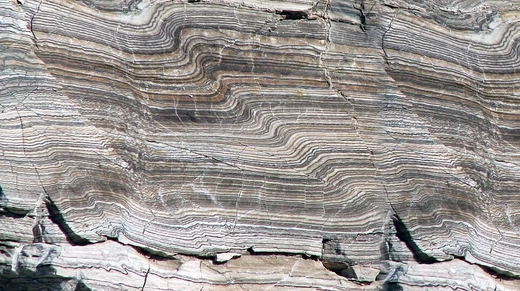
Tectonite
Rocks whose fabric records deformation history through mineral orientation.

Wikipedia / Wikimedia Commons
Tectonites are metamorphic or tectonically-deformed rocks whose fabric reflects the history of their deformation. They display coordinated geometric features indicating continuous solid (ductile) flow during formation. Planar foliation arises from parallel orientation of platey minerals such as phyllosilicates or graphite, while slender prismatic crystals like amphibole produce a lineation. Tectonites are studied through structural analysis to determine the orientation of shearing and compressive stresses during dynamic metamorphism, as well as the later or final stages of metamorphism.
- field
- Structural geology
- classification_groups
- L-tectonites, S-tectonites, L-S tectonites
- key_features
- Planar foliation, linear fabric, ductile flow
- mineral_phases
- Phyllosilicates, graphite, amphibole
Lore & Background
Tectonites are rocks whose minerals have been reoriented by natural earth forces, often involving recrystallization and foliation formation. The orientation of minerals allows structural geologists to infer the direction of shearing and compressive stresses during dynamic metamorphism, as well as the later stages of metamorphism. The fabric of tectonites reflects the history of their deformation, with planar foliation resulting from aligned platey minerals and lineation from aligned prismatic crystals.
Reader's Guide
Tectonites are significant in structural geology because they provide direct evidence of the stress and strain conditions that operated during metamorphism. By analyzing the orientation of planar and linear fabric elements, geologists can reconstruct the tectonic history of a region, including the direction of shearing and compressive forces. The classification into S-tectonites (dominant planar fabric, indicating flattening strain), L-tectonites (dominant linear fabric, indicating constrictional strain), and L-S tectonites (equally developed planar and linear fabric, indicating plane strain) allows for detailed interpretation of deformation regimes. For example, many mylonites are L-S tectonites consistent with simple shear deformation. This framework helps in understanding how matter moves during ductile flow in the Earth's crust.
Did You Know?
- Tectonites are classified into three main groups: L-tectonites, S-tectonites, and L-S tectonites.
- S-tectonites derive their name from the German word 'Schiefer' for schist.
- L-tectonites generally indicate a constrictional type of strain.
- Many mylonites are L-S tectonites consistent with simple shear deformation.
More in Structural Geology And Tectonics 1-24
Spotted an error? Know more?
This is a living reference — every entry is fact-audited, and reader corrections feed straight into our audit queue. Suggest an edit · See this site's audit record