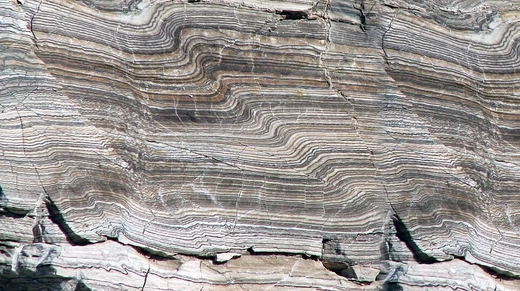
Accretionary wedge
Accretionary wedges form from sediments scraped off subducting plates.

Wikipedia / Wikimedia Commons
An accretionary wedge, also known as an accretionary prism, is a geological structure that forms at convergent plate boundaries from sediments accreted onto the non-subducting tectonic plate. Most of its material consists of marine sediments scraped off the downgoing slab of oceanic crust, though it may also include erosional products from volcanic island arcs. Accretionary wedges are significant because they preserve a record of tectonic collision and subduction processes, and their internal structure and geometry provide insights into pore fluid pressure, seismicity, and the evolution of continental margins.
- field
- Geology, Tectonics
- known_for
- Forming at convergent plate boundaries from accreted sediments; home of mélange; critical taper geometry
- key_materials
- Ocean-floor basalts, pelagic sediments, trench sediments (turbidites), olistostrome, piggy-back basins
- associated_phenomena
- Seismicity activating superimposed thrusts may drive methane and oil upraising; some tsunami events may result from rupture along basal decollement
Lore & Background
Accretionary wedges are composed of a mix of materials including ocean-floor basalts (typically seamounts scraped off the subducting plate), pelagic sediments immediately overlying oceanic crust, and trench sediments such as turbidites derived from oceanic, volcanic island arcs, continental volcanic arcs, or adjacent continental masses. Material may also be transported into the trench by gravity sliding and debris flow (olistostrome), and piggy-back basins can form in surface depressions on the wedge. Elevated regions like linear island chains, ocean ridges, and small crustal fragments (terranes) are transported toward the subduction zone and accreted to the continental margin.
Reader's Guide
Accretionary wedges are critical to understanding subduction zone dynamics and continental growth. Their internal structure resembles thin-skinned foreland thrust belts, with a series of thrusts verging toward the trench. The wedge's shape is determined by how readily it fails along its basal decollement and interior, highly sensitive to pore fluid pressure. Once a wedge reaches a critical taper, it maintains that geometry and grows only into a larger similar triangle. Pore pressure controls taper angle by modifying basal and internal shear strength; low-permeability and thick incoming sediment sustain high pore pressures and shallow tapers, while high-permeability and thin sediment produce steep tapers. Rapid tectonic loading of wet sediment can cause fluid pressure to rise until dilatant fracturing occurs, buffering wedge strength at cohesive strength. Backthrusting of the rear of the wedge arcward over forearc basin rocks is common. Accretionary wedges also provide natural laboratories for studying ophiolites—slices of oceanic crust thrust over the overriding plate—such as the Coast Range ophiolite of California.
Did You Know?
- Most of the geological basement of Japan is made up of accretionary complexes.
- Since the Late Devonian and Early Carboniferous periods, subduction beneath the western margin of North America has resulted in several collisions with terranes, adding an average of 600 km in width.
- Accretionary wedges are the home of mélange, intensely deformed packages of rocks that lack coherent internal layering.
- Pelayo and Weins postulated that some tsunami events have resulted from rupture through sedimentary rock along the basal decollement of an accretionary wedge.
More in Structural Geology And Tectonics 1-24
Spotted an error? Know more?
This is a living reference — every entry is fact-audited, and reader corrections feed straight into our audit queue. Suggest an edit · See this site's audit record