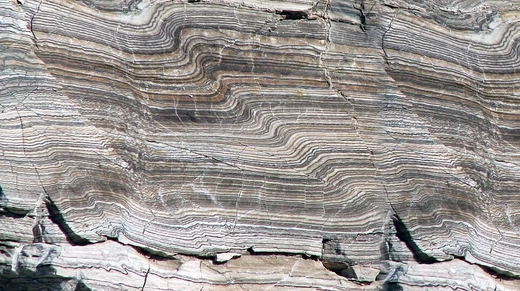
Ductility (Earth science)
Rock's ability to deform without fracturing under certain conditions.
In Earth science, a rock’s ductility is its ability to undergo large amounts of deformation without breaking apart in visible fractures. This kind of behavior shows up in loose or weakly cemented sediments, in soft minerals like halite, and, deeper underground, in any rock type where heat encourages crystals to shift and high pressure stops brittle cracking. When a rock deforms ductilely, it keeps a straight-line relationship between stress and strain even after passing its elastic limit, and the deformation spreads out over a broad area instead of concentrating along a single fault.
The brittle–ductile transition zone marks the depth where rock failure changes style. In continental crust, this happens at roughly 10–15 km (about 6.2–9.3 miles) down. Below that, rocks are less likely to fracture and more likely to flow. The zone exists because pressure rises with depth, making rocks stronger in a brittle sense, while rising heat weakens them in a ductile sense. The transition sits where brittle strength equals ductile strength. In glacial ice, this zone lies about 30 m (100 ft) deep. However, not every material follows this rule. Rocks above the transition can still deform ductilely, and those below can still break in a brittle way. Loose soils near the surface, soft rocks, and organic debris are examples that don’t behave according to the depth-based transition.
The dominant deformation process shapes the kinds of rocks and structures found at different crustal depths. In the shallow, brittle zone, gouge and breccia form. Deeper in the brittle regime, near the transition, cataclasite and pseudotachylite appear. Mylonite forms in the more ductile zone at greater depths, and blastomylonite occurs well past the transition, deep in the ductile regime.
Ductility can be measured mathematically, usually as the total elongation or the total change in cross-sectional area of a rock sample up to the point where it fractures. These measurements must be taken under controlled conditions—pressure, temperature, moisture, and sample size all affect the result. Even the same rock type can show different ductility because of small internal differences between samples. The two quantities are expressed as ratios or percentages. Percent elongation is calculated as (final length minus initial length) divided by initial length, times 100. Percent change in area is (final area
- field
- Earth science
- known_for
- Capacity of rock to deform to large strains without macroscopic fracturing
- key_quantification
- Percent elongation and percent change in cross-sectional area
- transition_zone_depth
- Approximately 10–15 km in continental crust; ~30 m in glacial ice
Lore & Background
Ductility in Earth science is a material property that can be expressed mathematically as a total quantity of elongation or change in cross-sectional area until macroscopic brittle behavior, such as fracturing, is observed. Accurate measurement requires controlled conditions including pressure, temperature, moisture content, and sample size, as even the same rock type may exhibit different degrees of ductility due to internal heterogeneities. The two common expressions are % elongation and % change in area, both calculated from initial and final dimensions of the sample.
Reader's Guide
The brittle–ductile transition zone marks a change in rock failure mode at an average depth of 10–15 km in continental crust, below which rock becomes less likely to fracture and more likely to deform ductilely. This zone exists because brittle strength increases with confining pressure while ductile strength decreases with increasing temperature; the transition occurs where brittle strength equals ductile strength. However, not all materials abide by this transition—material above the zone can deform ductilely, and material below can deform brittlely. The type of dominating deformation process influences the rocks and structures found at certain depths: gouge and breccia form in the uppermost brittle regime, cataclasite and pseudotachylite form near the transition zone, and mylonite and blastomylonite form in the ductile regime at greater depths. Ductile deformation can be grouped into elastic, viscous, and crystal-plastic categories, each with distinct stress-strain relationships and permanence of deformation.
Did You Know?
- Ductile deformation exhibits a linear stress vs strain relationship past the elastic limit.
- The brittle–ductile transition zone in continental crust occurs at an approximate average depth of 10–15 km.
- In glacial ice, the brittle–ductile transition zone is at approximately 30 m depth.
- Biological materials such as wood, lumber, and bone can be assessed for ductility similarly to rocks.
More in Structural Geology And Tectonics 1-24
Spotted an error? Know more?
This is a living reference — every entry is fact-audited, and reader corrections feed straight into our audit queue. Suggest an edit · See this site's audit record