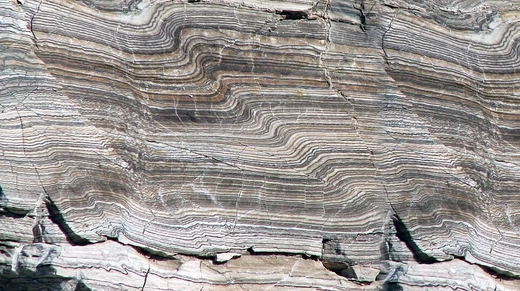
Diapir
A geological intrusion of mobile material into overlying rock.
A diapir is a type of geological intrusion in which a more mobile and ductilely deformable material is forced into brittle overlying rocks. The term was introduced by Romanian geologist Ludovic Mrazek, who first understood the principle of salt tectonics and plasticity. Diapirs can range from idealized mushroom-shaped Rayleigh–Taylor instability structures in low-tectonic-stress regions to narrow dikes moving along tectonically induced fractures.
- introduced_by
- Ludovic Mrazek
- field
- Geology
- type
- Intrusion structure
- common_materials
- Salt, mud, magma
- associated_bodies
- Earth, Triton, Europa, Enceladus, Miranda
Lore & Background
The term diapir comes from French diapir, from Ancient Greek διαπειραίνω (diapeiraínō) 'to pierce through'. Romanian geologist Ludovic Mrazek introduced the term and was the first to understand the principle of salt tectonics and plasticity. Diapirs commonly intrude buoyantly upward along fractures or zones of structural weakness through denser overlying rocks, a process known as diapirism, producing piercement structures.
Reader's Guide
Diapirs are significant in geology for their role in forming structures that trap hydrocarbons such as petroleum and natural gas. By pushing upward and piercing overlying rock layers, diapirs create anticlines and salt domes that can serve as reservoirs. The process of diapirism also occurs in the Earth's mantle, associated with large igneous provinces and some mantle plumes. Diapirs pose risks during drilling because segments of strata can become overpressured 'floaters' with pressures different from surrounding shallower strata. Observations suggest diapirism may occur on several moons in the solar system, including Neptune's moon Triton, Jupiter's moon Europa, Saturn's moon Enceladus, and Uranus's moon Miranda.
Did You Know?
- The term diapir derives from Ancient Greek meaning 'to pierce through'.
- Salt diapirs that reach the surface can flow as salt glaciers because salt becomes ductile with a small amount of moisture.
- Diapirism is thought to occur on Neptune's moon Triton, Jupiter's moon Europa, Saturn's moon Enceladus, and Uranus's moon Miranda.
- Overpressured 'floaters' from diapirs pose a significant risk when drilling through them.
More in Structural Geology And Tectonics 1-24
Spotted an error? Know more?
This is a living reference — every entry is fact-audited, and reader corrections feed straight into our audit queue. Suggest an edit · See this site's audit record