Crenulation
A fabric from superimposed foliations in metamorphic rocks.
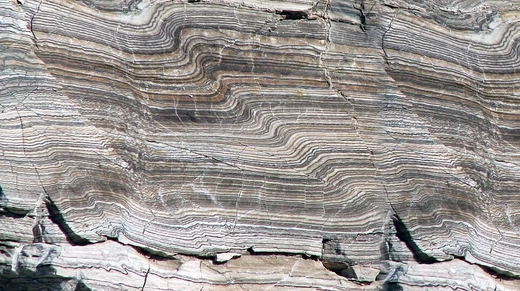
Crenulation, also known as crenulation cleavage, is a geological fabric formed in metamorphic rocks such as phyllite, schist, and some gneiss. It results from two or more stress directions causing the formation of superimposed foliations, preserving information about multiple deformation events.
- field
- Structural geology, metamorphic petrology
- known_for
- Diagnostic texture from superimposed foliations in metamorphic rocks
- related_concepts
- Foliation, intersection lineation, kink bands, porphyroblasts
Lore & Background
Crenulations form when an early planar fabric is overprinted by a later planar fabric, typically through recrystallization of mica minerals during metamorphism. Micaceous minerals create planar surfaces called foliations perpendicular to principal stress fields. If a rock undergoes two separate deformations at different angles, new micas grow on the foliation planes, creating a new foliation perpendicular to the later stress. The angular intersection of the two foliations produces the diagnostic crenulation texture, which may involve folding of the earlier mica foliations by the later one.
Reader's Guide
Recognizing a crenulation often requires a hand-lens or petrographic microscope, as it may be cryptic. It can manifest as kinking of previous foliation, with the original foliation appearing lined or inscribed by a later foliation. In advanced states, the later foliation forms distinct planes cross-cutting the earlier one, causing breaking, warping, and micro-scale folding. When the crenulation foliation dominates, it may totally or almost completely wipe out the original foliation. This process occurs at different rates in rocks of different lithology and composition, so examining a variety of outcrops is valuable. Crenulation may also act as an incipient shear plane, making reconstruction of earlier foliations difficult. Analysis of crenulations preserves information on both the stresses that formed the crenulation foliation and the orientation of previous foliations. The intersection of the initial foliation (S1) and the overprinting foliation (S2) forms an intersection lineation (L1-2), which may approximate the plunge of F2 interference folds. In brittle conditions, especially in highly micaceous rocks, crenulation may appear as kink bands without new mineral growth. In extreme cases, the S2 foliation obliterates the previous foliation, and porphyroblasts may be the only means to observe earlier foliations through inclusion trails.
Did You Know?
- Crenulations may be cryptic and require a hand-lens or petrographic microscope to recognize.
- The intersection of S1 and S2 foliations forms an intersection lineation that may approximate the plunge of F2 interference folds.
- In highly micaceous rocks under brittle conditions, crenulation may appear as kink bands without new mineral growth.
- Porphyroblasts may preserve inclusion trails of the S1 foliation when the S2 foliation has obliterated it elsewhere.
More in Structural Geology And Tectonics 1-24
Spotted an error? Know more?
This is a living reference — every entry is fact-audited, and reader corrections feed straight into our audit queue. Suggest an edit · See this site's audit record