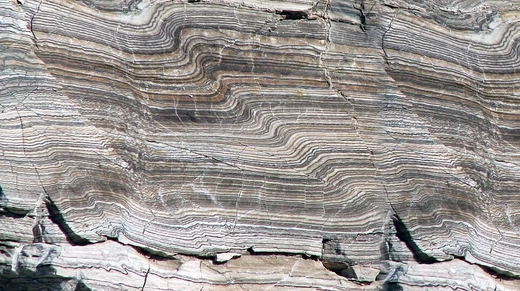
Continental crust
Continental crust forms the landmasses and shallow seabeds of Earth.
Continental crust is the rocky layer that makes up the continents and the shallow seabeds just offshore, called continental shelves. It is composed of igneous, metamorphic, and sedimentary rocks. Because it is rich in aluminum silicates, it is sometimes called sial, and it is less dense than oceanic crust, which is richer in magnesium silicates and known as sima. About 41% of Earth's surface and roughly 70% of the crust's total volume is continental crust.
Seismic wave data reveals a fairly sharp boundary, the Conrad discontinuity, separating the upper continental crust (more felsic) from the lower continental crust (more mafic). Most continental crust sits above sea level, but 94% of the Zealandia region is submerged under the Pacific Ocean; New Zealand makes up 93% of the above-water part.
The crust has an average density of about 2.83 g/cm³, less dense than the mantle (around 3.3 g/cm³) and also less dense than oceanic crust (about 2.9 g/cm³). It is much thicker than oceanic crust, ranging from 25 to 70 km thick, while oceanic crust averages only 7 to 10 km. Its bulk composition is intermediate, with about 60.6% silica by weight.
Because continental crust mostly sits above sea level, it allowed land life to evolve from marine life. It also created shallow seas and continental shelves where complex animals could establish themselves during the early Paleozoic, a period known as the Cambrian explosion.
All continental crust ultimately comes from mantle-derived melts, mainly basalt, through fractional differentiation of basaltic melt and the assimilation of older continental crust. Fractional differentiation is thought to be the dominant process, and these processes mostly happen at magmatic arcs tied to subduction zones. There is little evidence of continental crust older than 3.5 billion years. About 20% of today’s volume had formed by 3.0 billion years ago, with rapid growth on shield areas between 3.0 and 2.5 billion years ago, when about 60% of the current volume was created. The remaining 20% has formed over the last 2.5 billion years. Some scientists propose a steady-state hypothesis, arguing that the total volume has stayed roughly the same since early planetary differentiation and that the age distribution we see simply reflects which parts are preserved in cratons. This idea is not widely accepted.
Unlike the short-lived oceanic crust, contine
- thickness
- 25 to 70 km
- average density
- 2.83 g/cm³
- bulk composition
- intermediate (SiO₂ wt% = 60.6)
- surface area coverage
- 41% of Earth's surface
- volume of Earth's crust
- about 70%
- oldest intact fragment
- Acasta Gneiss at 4.01 Ga
Lore & Background
Continental crust is derived from mantle-derived melts, mainly basalt, through fractional differentiation and assimilation of pre-existing crust. These processes occur primarily at magmatic arcs associated with subduction. About 20% of the current volume was formed by 3.0 Ga, with rapid development between 3.0 and 2.5 Ga forming about 60% of the current volume. The remaining 20% has formed during the last 2.5 Ga. A steady-state hypothesis argues the total volume has remained similar after early planetary differentiation, but this is not generally accepted.
The crust is constantly changing through the supercontinent cycle. Because continental crust is less dense than oceanic crust, it is rarely subducted; the oldest rocks on Earth are within cratons. The height of mountain ranges relates to crustal thickness due to isostasy. The thinnest continental crust is found in rift zones. High temperatures and pressures cause much of the lower continental crust to be metamorphic. Continental crust is produced and destroyed mostly by plate tectonic processes, with new material added via partial melting of oceanic crust at subduction zones and accretion of volcanic island arcs. Loss occurs through erosion, sediment subduction, tectonic erosion, delamination, and deep subduction.
Reader's Guide
Continental crust is significant because its surface mainly lies above sea level, allowing land life to evolve from marine life and providing broad expanses of shallow water where complex metazoan life could become established during the Cambrian explosion. It is the best archive of Earth's history, as the oldest intact crustal fragment is the Acasta Gneiss at 4.01 Ga, while oceanic crust is much younger. The relative permanence of continental crust contrasts with the short life of oceanic crust. The growth of continental crust appears to have occurred in spurts of increased activity corresponding to five episodes of increased production through geologic time. The debate over whether the amount of continental crust has been increasing, decreasing, or remaining constant continues, with models indicating less than 10% of the present amount prior to 3.7 Ga ago. The existence of continental crust and its properties have shaped the geological and biological evolution of Earth.
Did You Know?
- 94% of the Zealandia continental crust region is submerged beneath the Pacific Ocean, with New Zealand constituting 93% of the above-water portion.
- The average density of continental crust is about 2.83 g/cm³, less dense than oceanic crust at about 2.9 g/cm³.
- The oldest intact crustal fragment is the Acasta Gneiss at 4.01 Ga.
- Approximately 41% of Earth's surface area and about 70% of the volume of Earth's crust are continental crust.
More in Structural Geology And Tectonics 1-24
Spotted an error? Know more?
This is a living reference — every entry is fact-audited, and reader corrections feed straight into our audit queue. Suggest an edit · See this site's audit record