Contact (geology)
A boundary separating rock bodies in geology.
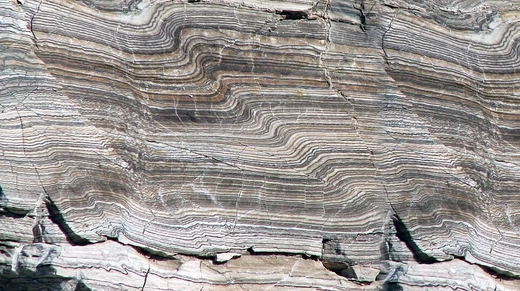
In geology, a contact is the boundary where one rock body meets another. These boundaries can result from sediment being laid down, magma pushing into existing rock, or through faulting and other deformation that shoves different rock bodies together. Stratigraphy, a branch of geology, focuses mainly on contacts formed during deposition, while structural geology pays special attention to faults and shear zones, which are considered secondary structures in rock layers.
**Types of Contacts**
**Depositional**
*Conformable*: These contacts show no missing time in the rock record. They are typically flat but can have slight irregularities. They indicate continuous, uninterrupted deposition of sediments or lava flows. An abrupt conformable contact separates beds of different rock types along a bedding plane, reflecting a change in the environment with only a brief pause (called a diastem) and no significant erosion. Gradational contacts form when the environment changes more slowly. They can be progressive, where the rock type shifts gradually, or intercalated, where thin layers of a new rock type appear at the bottom, become thicker upward, and eventually replace the old rock type entirely. Interfingering (also called intertonguing or interdigitating) happens when laterally adjacent sedimentary bodies wedge into each other, recording shifts in the boundary between different environments where sediments were deposited at the same time.
*Non-conformable*: Unconformities are gaps in the rock record within a sequence. These gaps arise from periods when no sediment was deposited or from erosion, so two adjacent rock units can have very different ages.
**Intrusive**
Intrusive contacts are the surfaces between older country rock and a younger body of magma that has pushed into it. The shape of the intrusion depends on the magma’s composition and depth; common examples include dikes, sills, plutons, and batholiths. The magma’s composition can give the intrusion a complex internal structure that reveals how it was emplaced. The country rock reacts to the intense heat in several ways. If the magma cools too quickly to fully crystallize, a chill margin forms—a fine-grained igneous rock along the border. The surrounding rock can be “baked” through contact metamorphism, turning into non-foliated metamorphic rocks. For instance, limestone becomes marble, quartz sandstone
- field
- Geology
- subdisciplines
- Stratigraphy, Structural geology
- types
- Depositional, Intrusive, Fault
- key_feature
- Boundary between rock bodies
- significance
- Determines relative ages and geological history
Lore & Background
Contacts are classified into several types. Depositional contacts include conformable contacts, which represent no time gap and can be abrupt or gradational, and non-conformable contacts (unconformities), which represent gaps in the geologic record due to non-deposition or erosion. Intrusive contacts occur where magma crosscuts older country rock, often producing chill margins or contact metamorphism. Fault contacts involve discrete breaks or ductile shear zones with displacement.
Reader's Guide
Contacts are essential for interpreting Earth's history. Conformable contacts indicate continuous deposition, while unconformities mark missing time. Intrusive contacts reveal the emplacement of igneous bodies and their effects on surrounding rock. Fault contacts help reconstruct deformation events. The cross-cutting relationships of contacts allow geologists to determine the relative sequence of geological events. Internationally, the golden spikes (GSSPs) on the geologic timescale are defined by specific contacts, such as the reddish layer in Tunisia marking the Cretaceous–Paleogene boundary. Understanding contacts is critical for creating accurate geological maps and for deciphering the geological history of an area.
Did You Know?
- A conformable contact can be abrupt, separating beds of distinct lithology with only a minor hiatus called a diastem.
- Interfingering contacts record fluctuations in the boundary between different depositional environments where sediments were simultaneously deposited.
- Intrusive contacts can produce chill margins of very fine-grained igneous rock if magma cools too quickly.
- The GSSP for the Danian Stage is a reddish layer at the base of a dark clay layer in Tunisia, representing the Iridium Anomaly from the Cretaceous mass extinction impact.
More in Structural Geology And Tectonics 1-24
Spotted an error? Know more?
This is a living reference — every entry is fact-audited, and reader corrections feed straight into our audit queue. Suggest an edit · See this site's audit record