Cleavage (geology)
Planar rock feature from deformation and metamorphism.
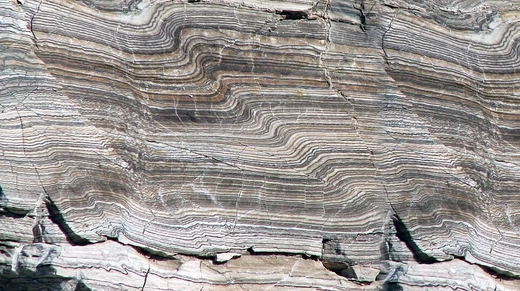
In structural geology and petrology, cleavage refers to a planar rock feature that forms through deformation and metamorphism. It is a kind of secondary foliation found in fine-grained rocks, where planar fabric elements align in a preferred direction. The classification used here follows Passchier and Trouw (2005). The type of cleavage that develops depends on the rock type and the intensity of deformation and metamorphism, and these structures typically arise in fine-grained rocks whose minerals are affected by pressure solution.
Cleavage is one form of rock foliation, which describes how planar features develop in a rock. Foliation is divided into primary (in igneous and sedimentary rocks) and secondary (in rocks that undergo metamorphism due to deformation). Cleavage is a secondary foliation specific to fine-grained rocks; for coarser-grained rocks, the term schistosity is used instead. Definitions of cleavage vary, leading to debate. Some authors apply "cleavage" to any secondary foliation, but here it is restricted to fine-grained rocks with planar fabric elements in a preferred orientation.
Cleavage is categorized as continuous or spaced, based on the presence of fabric elements like preferred orientation of platy or elongate minerals, compositional layering, or grain size variations.
**Continuous cleavage** occurs in fine-grained rocks where platy minerals are evenly distributed and aligned in a preferred orientation. The specific type depends on the minerals present: undeformed platy minerals like micas and amphiboles align, while minerals such as quartz or calcite deform into a grain-shape preferred orientation. Continuous cleavage is scale-dependent—a rock may appear to have continuous cleavage under a microscope but spaced cleavage at a larger scale. **Slaty cleavage** is a subtype defined by layers spaced 0.01 mm or less apart. It often forms after diagenesis and is the first cleavage to appear once deformation begins, requiring enough tectonic strain to create a strong new foliation.
**Spaced cleavage** develops in rocks where minerals are not evenly distributed, forming discontinuous layers or lenses of different minerals. It consists of two domains: cleavage domains (planar boundaries subparallel to the trend) and microlithons (the rock between these boundaries). Spaced cleavage can be classified by whether grains in the microlithons are
- field
- Structural geology and petrology
- known_for
- Planar rock feature resulting from deformation and metamorphism
- type
- Secondary foliation in fine-grained rocks
- classification
- Continuous or spaced cleavage
Lore & Background
Cleavage is a type of rock foliation, a fabric element describing how planar features develop in rock. Foliation is separated into primary (igneous and sedimentary) and secondary (metamorphic). Cleavage is a secondary foliation in fine-grained rocks; for coarser rocks, schistosity is used. There are various definitions for cleavage, which may cause confusion and debate. The article follows Passchier and Trouw (2005), who define cleavage as a secondary foliation in fine-grained rocks with planar fabric elements in preferred orientation. Some authors use cleavage for any secondary foliation.
Reader's Guide
Cleavage is categorized as continuous or spaced. Continuous cleavage (slaty cleavage) occurs in fine-grained rocks with evenly distributed platy minerals in preferred orientation, with slaty cleavage having 0.01 mm or less spacing. Spaced cleavage occurs in rocks with unevenly distributed minerals, forming discontinuous layers or lenses, and includes crenulation cleavage (microlithons warped by previous foliation), disjunctive cleavage (microlithons not deformed into microfolds), and transposition cleavage (older foliation erased by younger). Formation involves mechanical rotation of grains, solution transfer, dynamic recrystallization, and static recrystallization. Cleavage shows geometric relationship with fold axial planes, forming axial planar foliations. In folded sandstone-mudstone sequences, cleavage forms parallel to the axial plane in clay-rich parts, with fan-like arrangement. In geotechnical engineering, cleavage planes form discontinuities affecting rock mass behavior in construction.
Did You Know?
- Cleavage is a type of secondary foliation associated with fine-grained rocks.
- Slaty cleavage is defined as having 0.01 mm or less of space between layers.
- Disjunctive cleavage was formerly called fracture cleavage, but that term is now considered outdated.
- Cleavage planes form discontinuities that influence mechanical behavior in tunnel, foundation, or slope construction.
More in Structural Geology And Tectonics 1-24
Spotted an error? Know more?
This is a living reference — every entry is fact-audited, and reader corrections feed straight into our audit queue. Suggest an edit · See this site's audit record