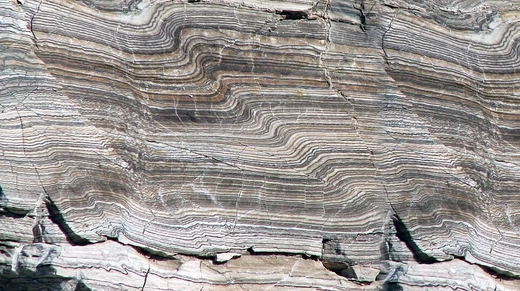
Brittle–ductile transition zone
Zone where brittle crust meets ductile crust.
The brittle-ductile transition zone is the region of the Earth's crust where the upper, brittle crust transitions to the lower, ductile crust. It marks the depth at which rock becomes less likely to fracture and more likely to deform ductilely by creep, and it is the strongest part of the crust where most shallow earthquakes occur.
- depth_in_continental_crust
- ~20 km
- temperature_range
- 250–400 °C
- depth_range_warm_young_crust
- 10–20 km
- depth_range_cool_old_crust
- 20–30 km
- key_rock_types
- quartz and feldspar-rich rocks
- associated_phenomena
- shallow earthquakes, electrical conductivity shift
Lore & Background
The brittle-ductile transition zone occurs at the depth where the downward-increasing brittle strength of rock equals the upward-increasing ductile strength, producing a characteristic 'saw-tooth' crustal strength profile. Its depth depends on strain rate and temperature gradient: it is shallower for slow deformation or high heat flow, and deeper for fast deformation or low heat flow. Crustal composition and age also affect depth, with warm young crust having a shallower transition zone (10–20 km) and cool old crust a deeper one (20–30 km).
The transition zone also marks a shift in electrical conductivity: the upper 10–15 km of crust is highly conductive due to electronic-conducting structures, while the lower crust is highly resistive, with conductivity determined by depth and temperature. Exceptions to the brittle-ductile behavior exist: rapid stress can cause fracturing below the transition zone, and gradual stress with pore fluids can cause ductile deformation above it.
Sections of fault zones once active in the transition zone, now exposed on land, show complex overprinting of brittle and ductile rock types, such as cataclasites or pseudotachylite breccias with mylonite clasts. A major example is the Salzach-Ennstal-Mariazell-Puchberg (SEMP) fault system in the Austrian Alps, where researchers have directly observed changes in structure and strength profiles.
Reader's Guide
The brittle-ductile transition zone is a fundamental concept in structural geology and geophysics, defining the depth at which the Earth's crust changes from brittle to ductile behavior. This zone is critical because it represents the strongest part of the crust and the primary locus of shallow earthquake generation. Understanding its depth and properties helps scientists interpret seismic hazard, crustal strength profiles, and the mechanical behavior of the lithosphere under different thermal and strain conditions. The transition zone's depth varies with factors such as strain rate, heat flow, and crustal age, making it a key parameter in models of tectonic deformation. Additionally, the zone marks a significant change in electrical conductivity, which aids in geophysical imaging of the crust. Exposed fault zones that once operated at transition-zone depths provide direct evidence of the interplay between brittle and ductile deformation, as seen in the SEMP fault system in the Austrian Alps. The concept also has parallels in materials science, where the ductile-brittle transition temperature describes similar behavior in materials under stress.
Did You Know?
- The transition zone occurs at the depth where brittle strength equals ductile strength, producing a 'saw-tooth' crustal strength profile.
- The transition zone is the strongest part of the crust and the depth at which most shallow earthquakes occur.
- The depth of the transition zone is shallower in warm, young crust (10–20 km) and deeper in cool, old crust (20–30 km).
- Exposed sections of the transition zone, such as along the SEMP fault system in the Austrian Alps, show complex overprinting of brittle and ductile rock types.
More in Structural Geology And Tectonics 1-24
Spotted an error? Know more?
This is a living reference — every entry is fact-audited, and reader corrections feed straight into our audit queue. Suggest an edit · See this site's audit record