Boudinage
Geological term for sausage-shaped structures from extension.
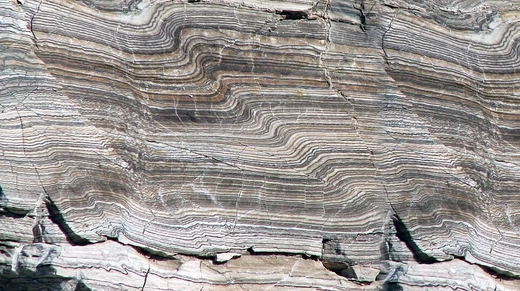
Boudinage describes a geological structure that forms when a rigid, tabular rock layer—like hornfels—is stretched and deformed while surrounded by softer, less resistant material. As the stronger layer is pulled apart, it breaks into segments that resemble sausages, called boudins. This process is widespread and can happen at any scale, from microscopic to the scale of entire lithospheric plates, and it appears in all types of rock terranes. In large-scale tectonics, the boudinage of strong layers can indicate the slow, creep-like transfer of rock material. Studying boudinage also helps geologists understand the forces involved in tectonic deformation and the strength of rocks.
Boudinage develops in two main ways: through planar fracturing that creates rectangular fragments, or through necking and tapering that produces elongated depressions and bulges. Boudins are typical features in sheared veins and shear zones, where stretching along the shear foliation and shortening perpendicular to it cause rigid bodies to break apart. This often gives boudins a characteristic sausage or barrel shape, though they can also be rectangular. Ductile deformation conditions favor boudinage over imbricate fracturing. The separated boudins may be divided by fractures or by vein material, and these gaps are called boudin necks.
In three dimensions, boudinage can appear as ribbon-like boudins or chocolate-tablet boudins, depending on the direction and isotropy of the extension. Their thickness ranges from about 20 meters down to about 1 centimeter.
There are three types of boudinage: no-slip, s-slip, and a-slip. No-slip boudinage occurs without any slip, producing a symmetrical structure. S-slip boudinage happens when the boudin moves opposite to the shear direction, while a-slip occurs when it moves with the shear. These types are further divided into five groups based on shape: drawn, torn, domino, gash, and shearband boudins. Generally, drawn and torn shapes form under no-slip conditions; domino and gash boudins result from a-slip; and shearband boudins come from s-slip.
The term boudinage was coined by Lohest in 1909, derived from the French word "boudin," meaning blood sausage. Boudins were first observed and described by Belgian geologists in the Collignon quarry near Bastogne in the Ardennes, Belgium.
- field
- Geology
- known_for
- Sausage-shaped rock structures formed by extension
- first_described_by
- Lohest (1909)
- etymology
- From French 'boudin', meaning blood sausage
Lore & Background
Boudinage can develop in two ways: planar fracturing into rectangular fragments or by necking or tapering into elongate depressions and swells. Boudins are typical features of sheared veins and shear zones where, due to stretching along the shear foliation and shortening perpendicular to this, rigid bodies break up. This causes the resulting boudin to take a characteristic sausage or barrel shape, though they can also form rectangular structures. Ductile deformation conditions encourage boudinage rather than imbricate fracturing. Boudins can become separated by fractures or vein material; such zones of separation are known as boudin necks.
In three dimensions, boudinage may take the form of ribbon-like boudins or chocolate-tablet boudins, depending on the axis and isotropy of extension. They range in size from about 20 m thick to about 1 cm. There are three different types of boudinage: no-slip, s-slip, and a-slip. No-slip boudinage occurs when there is no slip, resulting in a symmetrical structure. S-slip boudinage occurs when the boudin moves in opposition to the shear movement, whereas A-slip occurs when it moves with the direction of the shear. These types can be further classified into five groups with relation to their general shape: drawn, torn, domino, gash, and shearband boudins.
Reader's Guide
Boudinage is significant in structural geology as a key indicator of extensional deformation in rocks. Its study provides insight into the forces involved in tectonic deformation and the strength of rock layers. In lithospheric-scale tectonics, boudinage of strong layers can signify large-scale creep transfer of rock matter. The term was coined by Lohest in 1909, derived from the French word 'boudin' meaning blood sausage, and was first observed and described by Belgian geologists in the Collignon quarry near Bastogne in the Ardennes (Belgium). Boudinage occurs at all scales, from microscopic to lithospheric, and is found in all terranes. The classification into no-slip, s-slip, and a-slip types, along with the five shape-based groups (drawn, torn, domino, gash, shearband), allows geologists to interpret the kinematics of deformation. Understanding boudinage helps reconstruct the deformation history of rock masses and the rheological contrasts between competent and incompetent layers.
Did You Know?
- Boudinage can occur at any scale, from microscopic to lithospheric.
- The term 'boudinage' was coined by Lohest in 1909 from the French word 'boudin', meaning blood sausage.
- Boudins range in size from about 20 m thick to about 1 cm.
- Boudinage can develop by planar fracturing into rectangular fragments or by necking into elongate depressions and swells.
More in Structural Geology And Tectonics 1-24
Spotted an error? Know more?
This is a living reference — every entry is fact-audited, and reader corrections feed straight into our audit queue. Suggest an edit · See this site's audit record